Galaxy Formation
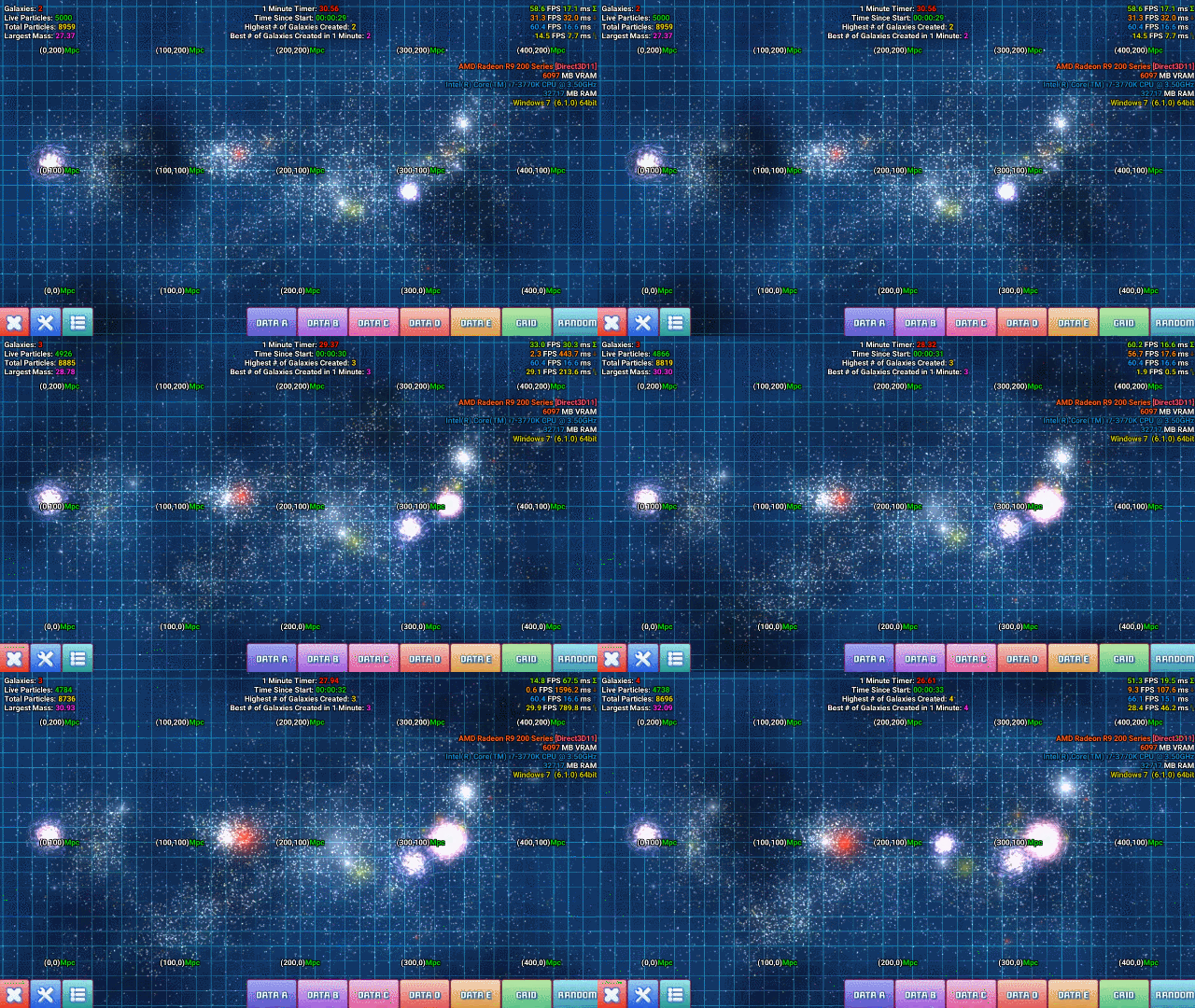
Multi-platform educational app depicting how dark matter particles clump together over billions of years to form stars, planets, and galaxies — powered by a real-time n-body simulation. Made in collaboration with CMU Physics and the NSF.
Overview
Galaxy Formation is a multi-platform educational app depicting how dark matter particles in the universe clump together over billions of years to form things like stars, planets, and galaxies. The app does this with a lite, real-time simulation of thousands of n-body particles attracted by gravitational forces — visually showing the emergence of large-scale cosmic structure from near-uniform initial conditions.
Made in collaboration with Rupert Croft and the McWilliams Center for Cosmology and Department of Physics at Carnegie Mellon University, and made possible with generous support from the National Science Foundation (NSF AST-1909193).
The Galaxy Formation App is available on the Android and iOS App Stores and playable live in the browser via WebGL.
Downloads & Platforms
- Live WebGL Demo — Play directly in the browser
- Android Build
- Windows Build
- Mac Build
- Linux Build
Key Features
- Real-time n-body gravity simulation of thousands of dark matter particles
- Watch billions of years of cosmic evolution play out in seconds
- Available on iOS, Android, Windows, Mac, Linux, and WebGL
- Designed for classroom and museum use
- Inspired by Volker Springel’s Gadget Simulation Code
Credits
Lead Developer: John Choi
Contributors:
- Doyee Byun
- Luka Jelenak
- Patrick LaChance
- Peter Lee
- Raphael Segal
- Ruihao Ye
- Rupert Croft
Additional Resources:
- 3D Black Hole Shader — Mikołaj Bystrzyński
- Lite FPS Counter — OmniSAR Technologies
- Lunar Mobile Console — SpaceMadness
- FastMobileBloom — becomealittlegirl
- Simple LUT Adjuster — Jeff Johnson
- Float Music — Emily A. Sprague
- Spacescape — Alex Peterson
- UI Gradient — azixMcAze
Funding: Made possible with generous support from the National Science Foundation (NSF AST-1909193), and the McWilliams Center for Cosmology and Department of Physics, Carnegie Mellon University.
Gallery